Skip to Content Skip to Footer
WIC Oregon logo
WIC Oregon logo
  • Домашняя страница
  • Женщины
  • Младенцы
  • Дети
  • Отцы
  • Russian (Русский)
    • English (English)
    • Spanish (Español)
    • Ukrainian (українська)
    • Vietnamese (Tiếng Việt)
    • Chinese (中國人)
    • Arabic (العربية)
    • Somali (Soomaali)
    • Dari (از)

Заявление о недискриминации

  • дом
  • Nondiscrimination Statement

Заявление о недискриминации

В соответствии с федеральным законодательством о гражданских правах, а также нормативными актами и политиками U.S. Department of Agriculture (USDA, Министерство сельского хозяйства США) о гражданских правах, USDA, его агентства, подразделения и сотрудники, а также учреждениям, участвующие в программах USDA или управляющие ими, не имеют права дискриминировать по признаку расы, цвета кожи, национального происхождения, религии, пола, особых потребностей, возраста, семейного положения, наличия детей, дохода от программ государственной помощи или политических убеждений, а также не имеют права осуществлять репрессии или преследовать за ранее осуществленную деятельность, связанную с гражданскими правами, в рамках любых программ или мероприятий, проводимых или финансируемых USDA (не все основания применяются ко всем программам). Средства правовой защиты и сроки подачи жалоб зависят от программы или конкретного случая.

Если у вас есть особые потребности и информация о программе нужна вам в альтернативном формате (например, шрифтом Брайля, крупным шрифтом, в виде аудиозаписи, в переводе на американский жестовый язык и т. д.), обратитесь в орган штата или местный орган, который управляет этой программой, либо свяжитесь с USDA через телекоммуникационную релейную службу по номеру 711 (голосовая связь и TTY). Кроме того, можно запросить перевод информации о программах с английского на другой язык.

Чтобы подать жалобу на дискриминацию в рамках программы, заполните форму жалобы AD-3027 на дискриминацию в программе USDA, доступную онлайн на странице How to File a Program Discrimination Complaint и в любом подразделении USDA, либо отправьте письмо в USDA, указав в нем всю информацию, требуемую в форме. Копию формы жалобы можно заказать по телефону (866) 632-9992. Отправить заполненную форму или письмо в USDA можно: (1) по почт: U.S. Department of Agriculture, Office of the Assistant Secretary for Civil Rights, 1400 Independence Avenue, SW, Mail Stop 9410, Washington, D.C. 20250-9410; (2) факсом: (202) 690-7442 ; (3) по электронной почте: program.intake@usda.gov

  • по почт: U.S. Department of Agriculture,
    Office of the Assistant Secretary for Civil Rights,
    1400 Independence Avenue, SW, Mail Stop 9410,
    Washington, D.C. 20250-9410
  • факсом: (202) 690-7442
  • по электронной почте: program.intake@usda.gov

USDA — это поставщик услуг, работодатель и кредитор, гарантирующий равные возможности.
WIC Oregon logo

Контактная информация

800 NE Oregon St, Suite 865
Portland, OR 97232
971-673-0040
www.healthoregon.org/wic

Дополнительная информация

  • Как подать заявку
  • Поиск клиники
  • Где можно делать покупки?

Ресурсы

  • План медицинского страхования штата Орегон
  • Помощь с грудным вскармливанием в рамках программы WIC
  • Отдел профилактики табакокурения штата Орегон
  • Oregon 211
  • Food Hero: рецепты
  • facebook
  • Youtube

USDA — это поставщик услуг, работодатель и кредитор, гарантирующий равные возможности.
Cookie PolicyПолитика конфиденциальности

© Brush Art Corporation

  • Email
  • SMS
If you are using multiple emails, separate them with commas.

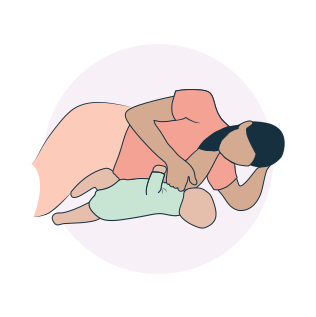
    Side-Lying

    Side-Lying Hold

    1. For the right breast, lie on your right side with your baby facing you.
    2. Pull your baby close. Your baby’s mouth should be level with your nipple.
    3. In this position, you can cradle your baby’s back with your left arm and support yourself with your right arm and/or pillows.
    4. Keep loose clothing and bedding away from your baby.
    5. Reverse for the left breast.

    This hold is useful when:

    • You had a C-section
    • You want to rest while baby feeds
    • You are breastfeeding in the middle of the night
    • You and your baby are comfortable in this position
    cross-cradle

    Cross-Cradle Hold

    1. For the right breast, use your left arm to hold your baby’s head at your right breast and baby’s body toward your left side. A pillow across your lap can help support your left arm.
    2. Gently place your left hand behind your baby’s ears and neck, with your thumb and index finger behind each ear and your palm between baby’s shoulder blades. Turn your baby’s body toward yours so your tummies are touching.
    3. Hold your breast as if you are squeezing a sandwich. To protect your back, avoid leaning down to your baby. Instead, bring your baby to you.
    4. As your baby’s mouth opens, push gently with your left palm on baby’s head to help them latch on. Make sure you keep your fingers out of the way.
    5. Reverse for the left breast.

    This hold is useful when:

    • Your baby is premature
    • Your baby has a weak suck
    • Your baby needs help to stay latched
    • Your baby needs extra head support
    • You and your baby are comfortable in this position
    Football

    Clutch or “Football” Hold

    1. For the right breast, hold your baby level, facing up, at your right side.
    2. Put your baby’s head near your right nipple and support their back and legs under your right arm.
    3. Hold the base of your baby’s head with your right palm. A pillow underneath your right arm can help support your baby’s weight.
    4. To protect your back, avoid leaning down to your baby. Bring baby to you instead.
    5. Reverse for the left breast.

    This hold is useful when:

    • You had a C-section
    • You have large breasts
    • You have flat or inverted nipples
    • You have a strong milk let-down
    • You are breastfeeding twins
    • Your baby likes to feed in an upright position
    • Your baby has reflux
    • You and your baby are comfortable in this position
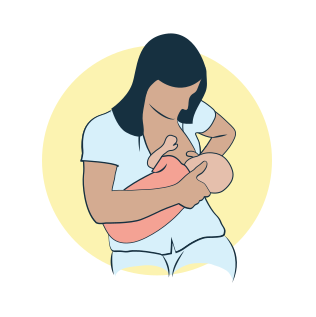
    CRADLE hold

    Cradle Hold

    1. For the right breast, cradle your baby with your right arm. Your baby will be on their left side across your lap, facing you at nipple level.
    2. Your baby’s head will rest on your right forearm with your baby’s back along your inner arm and palm.
    3. Turn your baby’s tummy toward your tummy. Your left hand is free to support your breast, if needed. Pillows can help support your arm and elbow.
    4. To protect your back, avoid leaning down to your baby. Instead, bring your baby to you.
    5. Reverse for the left breast.

    This hold is useful when:

    • Your baby needs help latching on
    • You and your baby are comfortable in this position
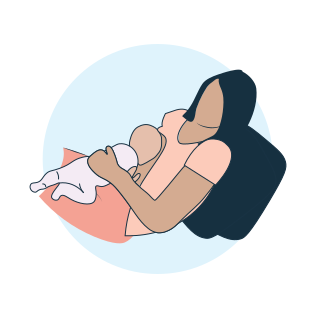
    laid-back

    Laid-Back Hold

    1. Lean back on a pillow with your baby’s tummy touching yours and their head at breast level. Some moms find that sitting up nearly straight works well. Others prefer to lean back and lie almost flat.
    2. You can place your baby’s cheek near your breast, or you may want to use one hand to hold your breast near your baby. It’s up to you and what you think feels best.
    3. Your baby will naturally find your nipple, latch, and begin to suckle.

    This hold is useful when:

    • Your baby is placed on your chest right after birth
    • You have a strong milk let-down
    • You have large breasts
    • You and your baby are comfortable in this position